CHRYSOCOLLA
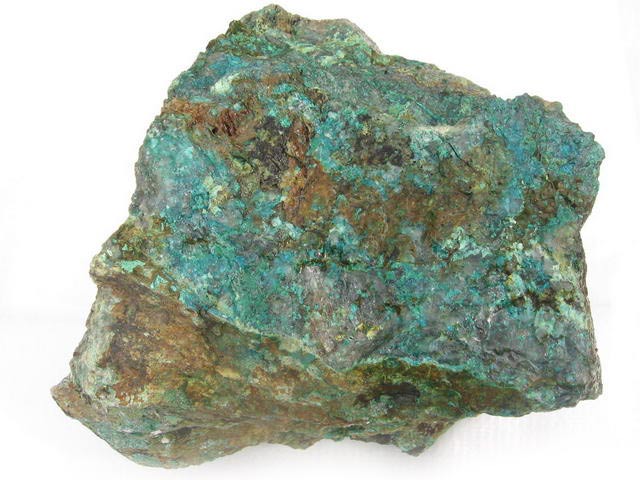
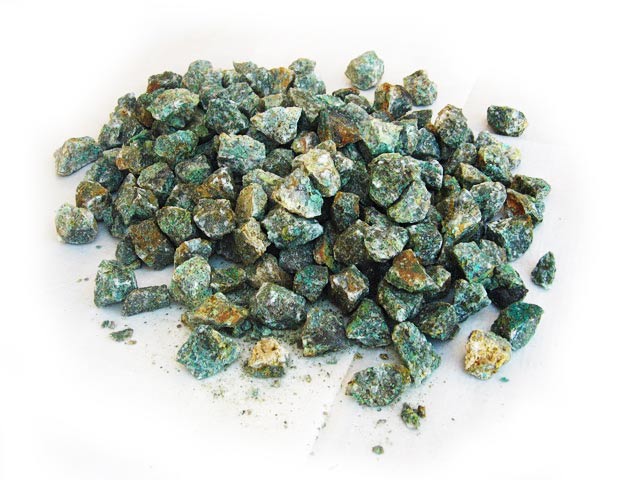
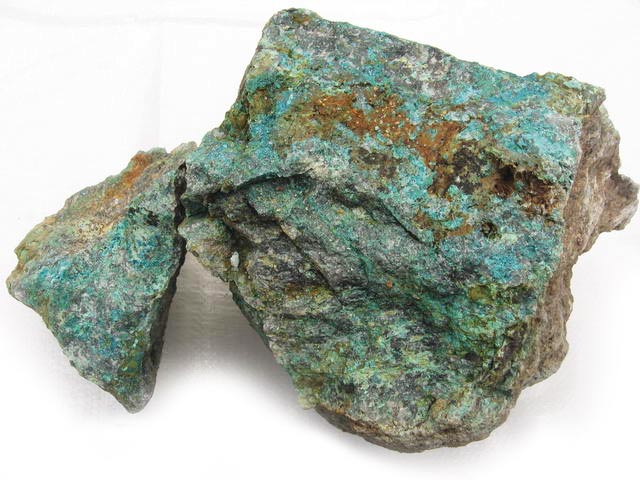
 Chrysocolla has an attractive blue-green colour and is a minor ore of copper, having a hardness of 2.5 to 3.5. Chrysocolla has an attractive blue-green colour and is a minor ore of copper, having a hardness of 2.5 to 3.5.
The name comes from the Greek chrysos, "gold", and kolla, "glue", in allusion to the name of the material used to solder gold, and was first used by Theophrastus in 315 BCE.
It is of secondary origin and forms in the oxidation zones of copper ore bodies. Associated minerals are quartz, limonite, azurite, malachite, cuprite, and other secondary copper minerals.
It is typically found as glassy botryoidal or rounded masses and crusts, or vein fillings. Because of its light color, it is sometimes confused with turquoise. Commonly it occurs only as pourous crusts unsuitable for gem use, but high quality, gem grade chrysocolla can be translucent and is highly prized.
Notable occurrences include Israel, Democratic Republic of Congo, Chile, Cornwall in England, and Arizona, Utah, New Mexico and Pennsylvania in the United States.
Auric Cleanser, Support, Soothes and Calms Primary Chakras: Heart, Throat, Thymus (Second Heart) Third Eye Astrological signs: Gemini, Virgo, Taurus
Physical properties of Chrysocolla:
Category: Silicate mineral
Stone Type/Family: A member of the Silicates Class
Chemical formula: (Cu,Al)2H2Si2O5(OH)4·nH2O
Aluminum Silicate. More often than not, Chrysocolla is found as a secondary mineral to Malachite, Azurite, Shattuckite and/or Turquoise.
Color: Blue, blue-green, green
Crystal habit: Massive, nodular, botryoidal
Crystal system: Orthorhombic
Cleavage: none
Fracture: Brittle to sectile
Mohs scale hardness: 2.5 - 3.5
Luster: Vitreous to dull
Streak: white to a blue-green color
Diaphaneity: Translucent to opaque
Specific gravity: 1.9 - 2.4
Optical properties: Uniaxial (+)
Refractive index: nù = 1.460 nå = 1.570
Birefringence: +0.110
Location: Angola, Australia, Bolivia, Chile, Madagascar, Mexico, Namibia, Republic of the Congo, Russia, UK, USA, Zaire, Zambia
Rarity: Common
Fun Fact: In its gemmy state, Chrysocolla is known as Gem Silica
Metaphysical guide of Chrysocolla:
Auric Cleanser, Support, Soothes and Calms
Primary Chakra: Heart, Throat, Thymus (Second Heart) Third Eye
Astrological sign(s): Gemini, Virgo, Taurus
Vibration: Number 5
Chrysocolla is a very peaceful stone. It is soothing and calming in times of stress, bringing about a gentle release. Chrysocolla gently draws off negative energies of all kinds and is especially helpful during transitional times, such as breakups and job loss, among other similar situations. By the same token, Chrysocolla can help calm the emotions and bring understanding to discordant relationships.
Chrysocolla is a wonderful piece to use, on a daily basis, as a support stone. It helps to face challenges and changes with ease. Chrysocolla inspires creativity, inner balance and self-awareness. Chrysocolla can be used where feelings of anger, guilt and blame are present. It will gently assist in the awareness and understanding of this process and will bring in the energies of forgiveness, love and joy.
Chrysocolla is a powerful stone because it aligns all chakras with the Divine.
Chrysocolla is a tranquil stone. Chrysocolla can be used with the Throat Chakra, where it helps with wise communication, or with the Heart Chakra to balance and strengthen, helping one to learn how to live from the truth of the Heart. It can also be used to open and activate the Thymus, or Second Heart Chakra. Chrysocolla has been used with the Third-Eye to enhance meditation, bringing visions and knowledge of the sublime into conscious awareness.
Physically, Chrysocolla can help heal ailments of the lungs, back, and stomach.
Back to Metaphysical and Physical Guide
Sources:
HealingCrystals.com - Wikipedia
|